River taf water testing results -June 26

Updated: Jun 12
River Taf Monitoring Update — June 2026
The Laugharne Citizen Science completed its latest monthly water quality survey across the River Taf catchment on 9 June 2026, testing at four sites from Login in the upper catchment down to Llandowror. The results present an interesting and scientifically significant picture — one that illustrates both the resilience of the river and the value of continuous, multi-point monitoring.
The headline finding: a sharp drop in pH
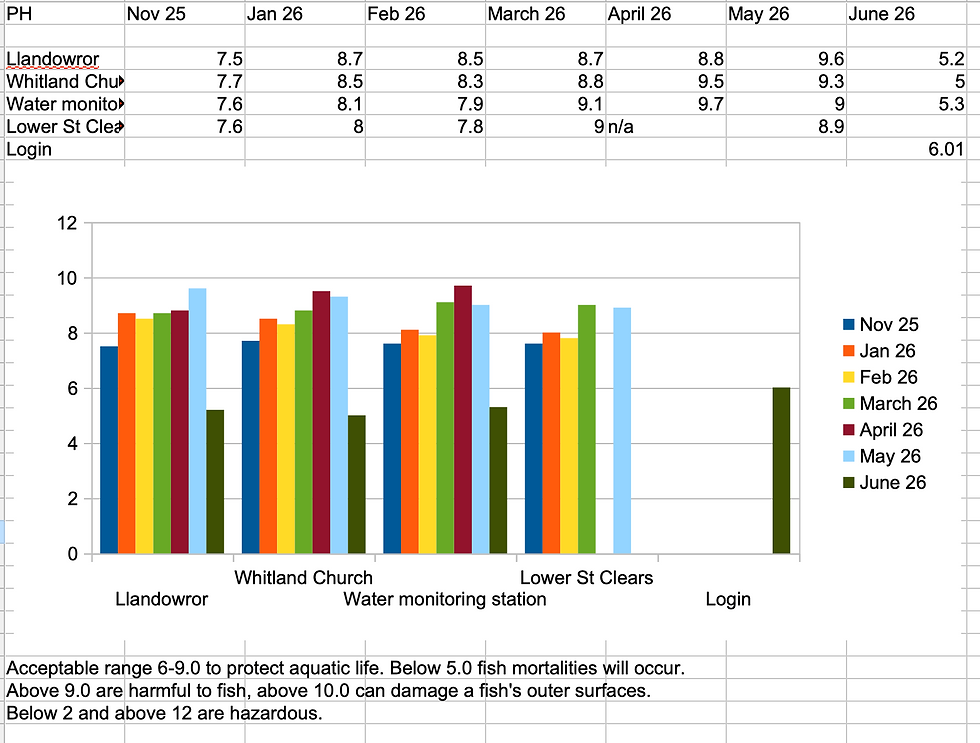
The most striking result this month is a significant fall in pH across all tested sites. Readings ranged from 6.01 at Login down to 5.0 at Whitland Church, with the Water monitoring station at 5.3 and Llandowror at 5.2. To put this in context, the acceptable range for protecting aquatic life is 6.0–9.0. Whitland Church is currently below that threshold, and while the other sites are at or near the lower boundary, this represents a marked reversal from the elevated spring readings, which peaked above 9.0 at several locations in April and May — levels that are themselves harmful to fish.
The dissolved oxygen readings across all four sites in June are healthy, ranging from 10.0 to 10.8 mg/L. This is important because an acute agricultural pollution event — slurry or silage effluent entering the river, for example — would typically cause dissolved oxygen to crash as bacteria break down the organic load. The fact that oxygen levels remain strong suggests the river is not currently suffering from that type of contamination.
The upstream position of Login is informative here. With pH already at 6.01 at the highest monitoring point and falling to 5.0 by Whitland Church, the acidification appears to be developing as water moves downstream rather than flushing in from the upper headwaters.
Other parameters
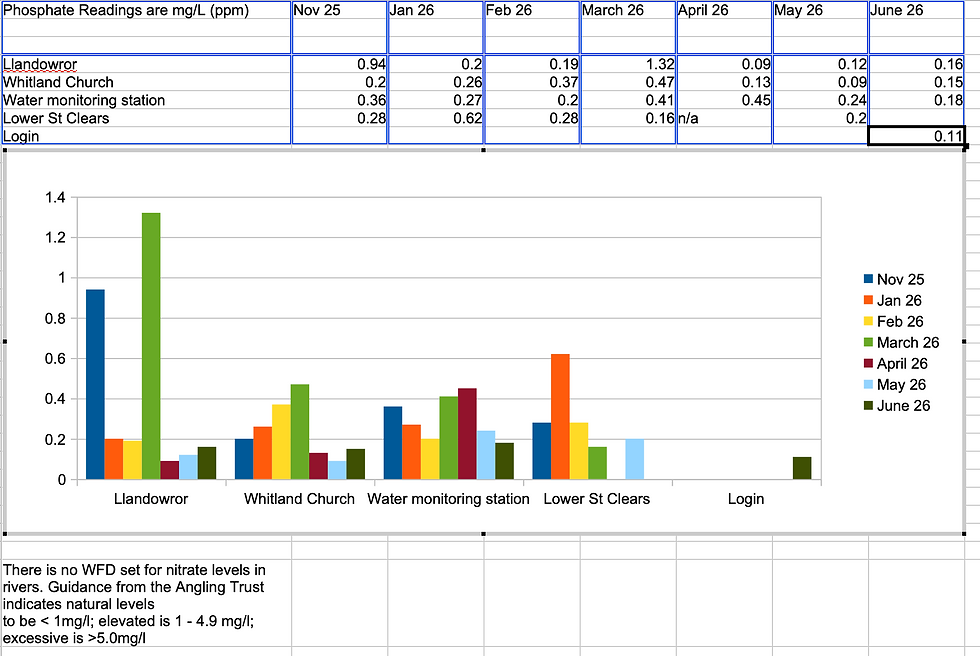
Ammonia levels are well within safe limits at all sites. Nitrates are in the elevated but not excessive range across the catchment. Phosphates are low — a contrast to March, when a notable spike of 1.32 mg/L was recorded at Llandowror, an anomaly we continue to investigate.
What happens next
We will report back with the follow-up results as soon as they are available.
(Please note these comments were created by Claude AI on analysis of the results)





Comments