River Taf-Water testing results July 2026

River Taf Water Quality Report: July 2026 Analysis & Historical Comparison
This report summarises the water quality measurements taken across the River Taf in July 2026 at the Llandowror, Whitland Church, Water monitoring station, Login, and Glogue locations, comparing recent data against historical results dating back to November 2025.
In line with summer weather patterns, water temperatures increased across all stations in July 2026, reaching approximately 20°C . This temperature increase corresponds with the monthly weather log, which noted a shift from "Sun/Cloud" in June to "Sun/Hot" conditions in July. Concurrently, the pH values at the long-standing monitoring stations returned to standard, near-neutral ranges between 6.4 and 6.9, recovering from the lower, more acidic readings observed in June. Dissolved oxygen saturation remained strong, healthy, and stable across all five testing locations, ranging from 9.8 mg/L to 11.2 mg/L.
July 2026 marks the first month of data collection for Glogue, a newly added monitoring location on the river. As a new site, it currently lacks a historical baseline for comparison. It recorded an initial pH of 10.1, a nitrate measurement of 2.7 mg/L, and an electrical conductivity reading of 257 mS/cm. Because standard guidelines indicate that pH readings above 9.0 can be stressful for river ecosystems, this location will require consistent ongoing tracking in future testing rounds to establish its true operational norm and determine if this is a regular local characteristic.
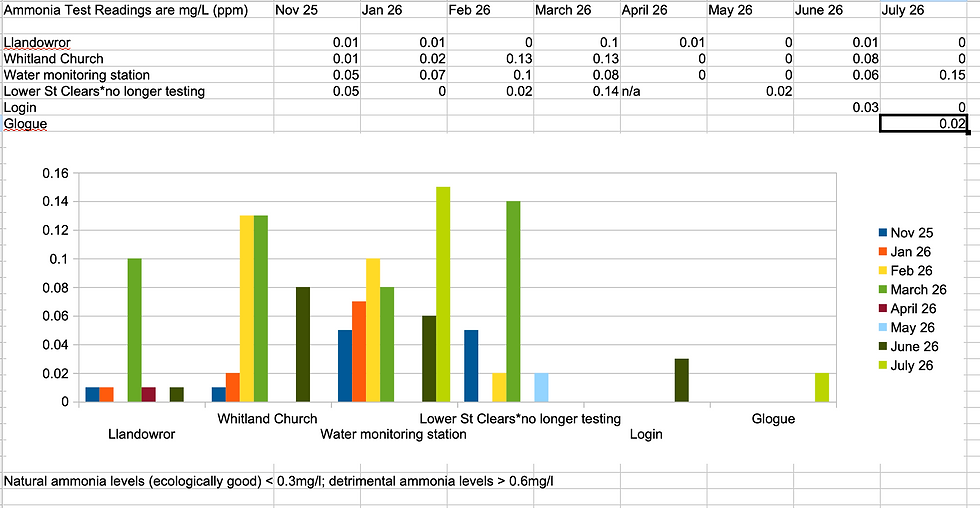
Varied nutrient and mineral levels were observed across the rest of the catchment this month. Phosphate levels at Llandowror (0.54 mg/L) and the Water monitoring station (0.53 mg/L) moved higher this month, though historical data shows these levels remain lower than the peaks recorded earlier in the spring. Meanwhile, the phosphate level at Whitland Church remained flat at 0.17 mg/L. Nitrate concentrations remain at their typical, ecologically good levels, hovering between 1.0 mg/L and 1.8 mg/L. Ammonia remained completely at baseline (0.00 mg/L) at Llandowror, Whitland Church, and Login, with a minor baseline variance of 0.15 mg/L picked up at the Water monitoring station, which sits well within the ecologically safe threshold of less than 0.3 mg/L.
Routine follow-up focus areas for the coming months will include the continued assessment of the new Glogue site to monitor its long-term pH trends. Additionally, standard seasonal nutrient fluctuations and a slight rise in Electrical Conductivity at Whitland Church to 268 mS/cm—just above the standard 250 mS/cm healthy reference mark—will continue to be tracked as part of our monthly testing programme.
Overall the river seems to be in good condition on the basis of this survey with just one or two areas for a watching brief to be maintained.


Comments